
an the 2M2 TANK CNC Key Cutting Machine cut multi-point keys? And do you need to change the guide or tracer before cutting?
This is a question we recently received from a 2M2 TANK user:
“Do you need a different guide for a multipoint key?”
The short answer is:
For the multi-point key application shown here, use the M Φ4mm Multi-Point Cutter together with the 0.5 Probe Φ6mm.
The important thing is to distinguish between the cutter and the probe (guide/tracer).
Let’s take a closer look at the correct setup.
2M2 TANK Multi-Point Key Cutter & Probe Setup
According to the 2M2 TANK house key cutter reference, the recommended combination for the multi-point key shown is:
| Tool | Model | Application |
|---|---|---|
| Cutter | M Φ4mm | Cutter for Multi-Point Key |
| Probe / Guide | 0.5 Probe Φ6mm | Probe for House Key |
Correct Combination:
M Φ4mm Multi-Point Cutter + 0.5 Probe Φ6mm
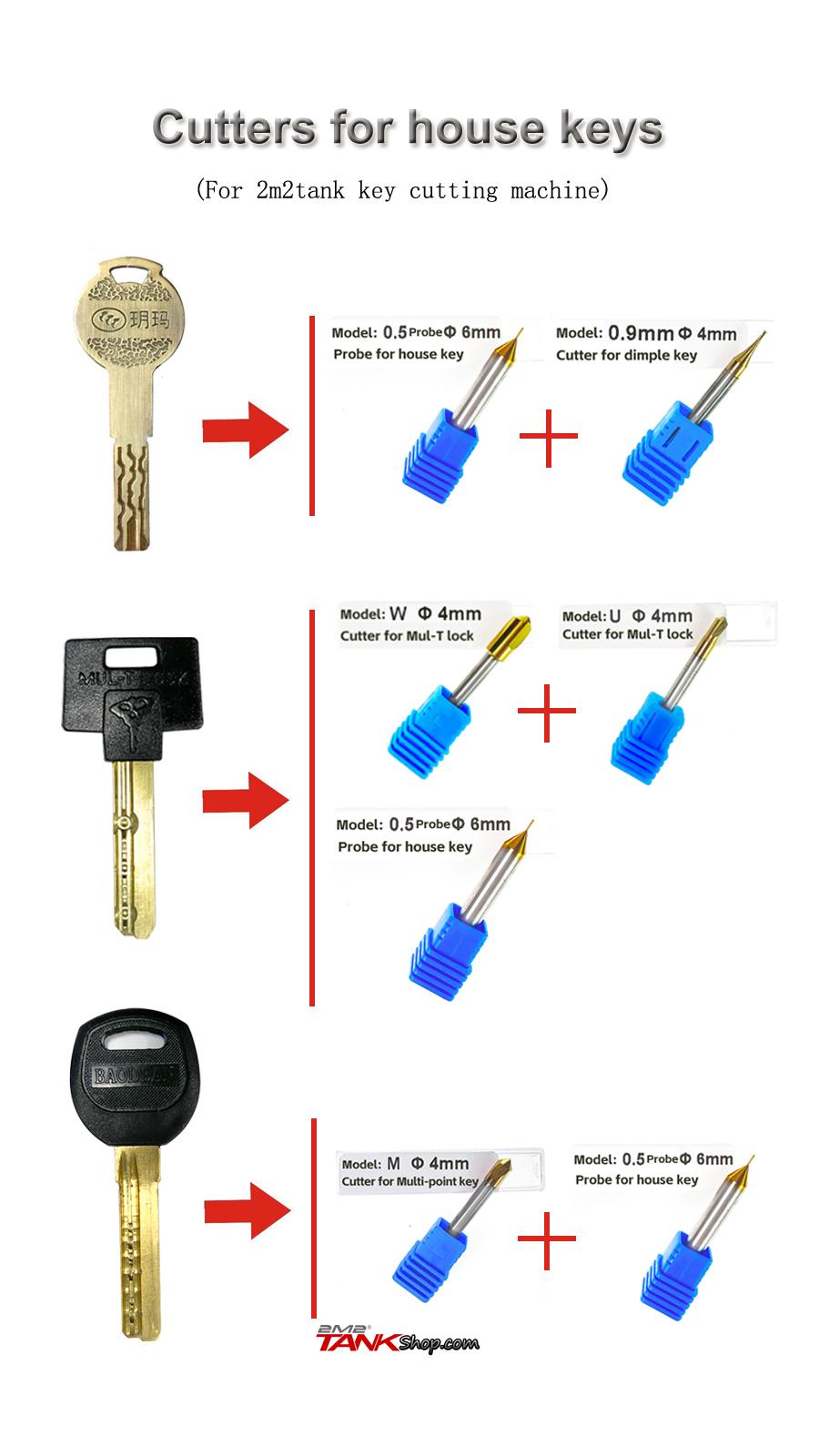
[INSERT IMAGE: Cutters for House Keys]
Image ALT: 2M2 TANK cutters and probe for multi-point and dimple house keys
So, if you’re asking whether a multi-point key uses a special cutting tool, the answer is yes — the correct M Φ4mm cutter should be used for this multi-point application.
For the probe/guide side, the reference specifies the 0.5 Probe Φ6mm.
Important: Before cutting, check which cutter and probe are currently installed on your machine. Do not assume that the tool already installed is the correct one for every type of house key.
Cutter vs Probe: What’s the Difference?
This is an important distinction, especially for users who are new to cutting residential or multi-point keys with 2M2 TANK.
Cutter
The cutter is the cutting tool that actually removes material from the key blank.
Different key structures may require different cutter shapes or dimensions.
For the multi-point key application shown in the reference:
Use: M Φ4mm Cutter for Multi-Point Key
Probe / Guide / Tracer
The probe is used for measurement, decoding or guiding operations depending on the workflow.
It may also be referred to by users as a:
- Guide
- Tracer
- Probe
For the multi-point key application shown here:
Use: 0.5 Probe Φ6mm
Therefore, when asking:
“Do I need a different guide for a multipoint key?”
the first thing to check is whether your current probe is already the specified 0.5 Probe Φ6mm.
Different House Keys Require Different Tool Combinations
The 2M2 TANK cutter reference also shows that different residential key structures require different cutter combinations.
This is why it’s important not to use one cutter for every house key application.
Dimple Key
For the dimple key application shown in the reference:
0.9mm Φ4mm Dimple Cutter + 0.5 Probe Φ6mm
The 0.9mm cutter is specifically identified for dimple key cutting.
Watch the Dimple Key Cutting Demo
This video demonstrates the actual setup and operation for cutting a dimple key with the 2M2 TANK.
Multi-Point / Mul-T-Lock Key
For the Mul-T-Lock example shown in the cutter reference, the setup includes dedicated cutters:
W Φ4mm Cutter for Mul-T-Lock
U Φ4mm Cutter for Mul-T-Lock
0.5 Probe Φ6mm
This is another good example of why the correct cutter configuration matters when working with specialized residential keys.
Multi-Point Key
For the multi-point key example:
M Φ4mm Cutter for Multi-Point Key
0.5 Probe Φ6mm
The M Φ4mm cutter is designed for the multi-point key application shown in the reference.
Watch the Multi-Point Key Cutting Demo
The video shows the actual multi-point key setup and cutting process in detail.
If you’re unsure how the cutter, probe and key blank should be positioned, we strongly recommend watching the complete operation before cutting.
How to Cut a Multi-Point Key with 2M2 TANK
The exact workflow can vary depending on the key profile, but the general process is as follows.
Step 1: Identify the Key Type
First, confirm that the key you’re working with matches the supported multi-point key application.
Do not select a cutter based only on the general appearance of the key.
Step 2: Select the Correct Key Data
Open the 2M2 TANK App and locate the corresponding house key / multi-point key information.
Make sure the selected key profile matches the actual key blank.
Step 3: Check the Cutter
For the multi-point application covered in this guide, install:
M Φ4mm Cutter for Multi-Point Key
Make sure the cutter is properly installed and secured before starting the operation.
Step 4: Check the Probe
Use:
0.5 Probe Φ6mm
If your machine already has this probe installed, you may not need to replace the probe itself.
However, always verify the model before proceeding.
Step 5: Position the Key Correctly
Install the key blank according to the instructions shown in the 2M2 TANK App.
Correct positioning is essential for accurate decoding and cutting.
Step 6: Follow the App and Start Cutting
Once the correct:
- Key profile
- Cutter
- Probe
- Clamp position
have all been confirmed, follow the instructions in the 2M2 TANK App to complete the cutting operation.
Why the Correct Cutter Matters
Using the correct cutter isn’t simply a recommendation.
Different key structures have different:
- Groove designs
- Cutting positions
- Cutting depths
- Hole/dimple shapes
- Blade structures
A cutter designed for one type of key may not be appropriate for another.
For this reason, always check the cutter specification before starting a specialized house key job.
Quick Reference: 2M2 TANK House Key Cutters
| Key Type | Cutter | Probe |
| Dimple Key | 0.9mm Φ4mm | 0.5 Probe Φ6mm |
| Mul-T-Lock | W Φ4mm + U Φ4mm | 0.5 Probe Φ6mm |
| Multi-Point Key | M Φ4mm | 0.5 Probe Φ6mm |
Note: This table reflects the applications shown in the provided 2M2 TANK cutter reference. Always confirm the exact key profile and tool requirements in the 2M2 TANK App before cutting.
Watch the Actual 2M2 TANK Key Cutting Videos
If you’re still unsure which cutter or probe to use, the easiest way to understand the setup is to watch the actual operation.
Dimple Key Cutting
Dimple / Multi-Point Key Cutting
These videos show the machine setup, key positioning and cutting process in detail.
FAQ
Can 2M2 TANK cut multi-point keys?
Yes. 2M2 TANK supports multi-point key cutting when the correct key profile, cutter, probe and setup are used.
Which cutter is used for a multi-point key?
For the multi-point application shown in the 2M2 TANK cutter reference, use the M Φ4mm Cutter for Multi-Point Key.
Which probe is used for a multi-point key?
The reference specifies the 0.5 Probe Φ6mm.
Do I need to change the guide/tracer for a multi-point key?
Check which probe is currently installed on your machine.
For the application shown here, the specified probe is the 0.5 Probe Φ6mm. If this is already installed, the probe itself may not need to be changed. The cutter, however, must match the required multi-point application.
Can I use the dimple cutter to cut a multi-point key?
Do not assume the cutters are interchangeable.
The supplied reference identifies the 0.9mm Φ4mm cutter for the dimple key and the M Φ4mm cutter for the multi-point key.
Always use the cutter specified for the selected key application.
What if I’m not sure which cutter to use?
Check the key profile in the 2M2 TANK App and compare it with the cutter reference before cutting.
You can also watch the operation videos above to see the actual setup.
Conclusion
So, does the 2M2 TANK need a different guide when cutting a multi-point key?
For the multi-point key application covered in this guide, the recommended setup is:
M Φ4mm Multi-Point Cutter + 0.5 Probe Φ6mm
The main point is that the cutter and probe are two different tools.
The multi-point key requires the appropriate M Φ4mm cutter, while the specified probe is the 0.5 Probe Φ6mm.
Before starting any specialized residential key cutting job, always confirm the exact key profile and corresponding cutter/probe configuration.
Using the correct tools helps ensure accurate cutting and reduces the risk of damaging the key blank or using the wrong cutter.